
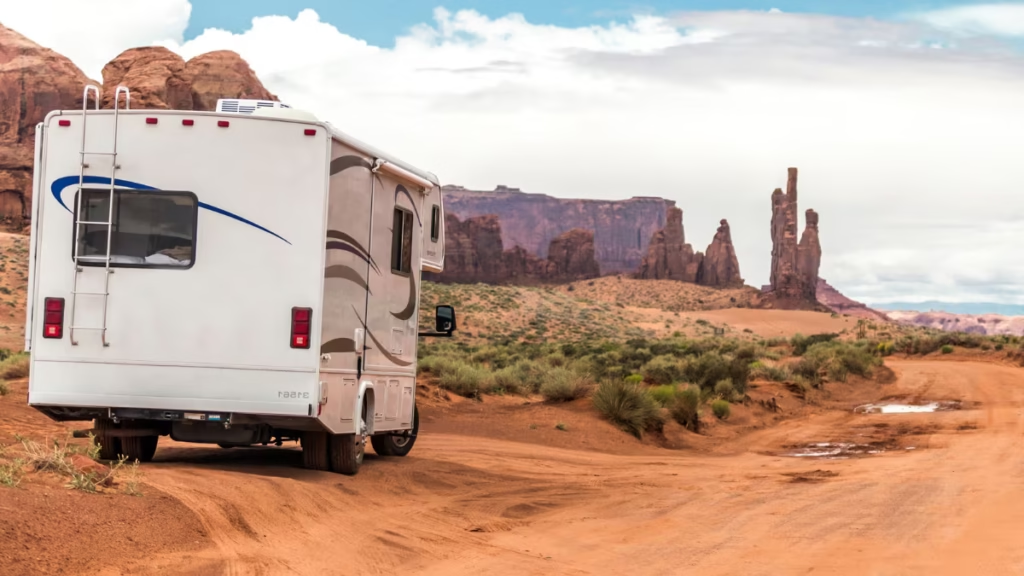
How to boondock for the first time is one of those topics that looks straightforward on the surface but hides a dozen practical decisions underneath, decisions that separate a genuinely memorable trip from two frustrating days of managing systems you did not fully understand before you left.
This guide is written for two kinds of people. The first is someone who has never camped without hookups and genuinely does not know where to start. The second is someone who has spent plenty of nights at campgrounds with power, water, and sewer connections, and is now ready to cut the cord. Both will find what they need here.
Boondocking, also called dispersed camping or dry camping, means parking and sleeping on public land without any hookups at all. No electricity. No running water. No dump station nearby. Just your rig, your supplies, and however much land stretches out around you. Done right, it is one of the most satisfying ways to travel in an RV. Done wrong, it is two days of anxiety followed by a frantic drive to find a dump station.
Let us make sure it goes the right way.
What Boondocking Actually Means and Why It Feels Different
Most campgrounds, even primitive ones, offer some form of infrastructure. A designated site, a fire ring, a bathroom within walking distance, and often an electrical hookup. You show up, plug in, and the campground handles the rest.
Boondocking removes all of that. You are fully self-contained. Your RV’s battery bank powers your lights and refrigerator. Your fresh water tank is your only water supply. Your gray and black tanks have to hold everything until you find a dump station. There is no ranger station nearby and often no cell signal. The sites are free and first-come, first-served, but they come with the full weight of self-sufficiency.
That shift in responsibility is what trips up first-timers who are used to hookup camping. The habits that work fine at a campground, running the faucet freely, leaving lights on, charging everything at once, become problems overnight when there is nothing feeding the system from outside.
The good news is that once you understand the four systems you are managing, water, power, waste, and propane, boondocking stops feeling complicated and starts feeling like a skill. One you get better at with every trip.
How to Choose the Right First Boondocking Spot
Before you look at a single location, understand this: your first boondocking trip should be short, close, and low-stakes. A lot of first-timers set their sights on some remote desert canyon they saw on Instagram and then discover, 40 miles down a washboard dirt road, that they forgot to fill the water tank, the battery is already at 60 percent, and it gets dark in two hours.
Start close to civilization. Within an hour of a town you trust. Plan for two nights, not a week. Pick somewhere with decent road access for your rig. Give yourself permission to leave early if something is not working.
The goal of the first trip is not to have the perfect boondocking experience. It is to learn what your rig actually does without hookups, and what you personally find hard to manage. That information is more valuable than any number of videos you can watch beforehand.
A few summers back, I made the mistake of going too far on a first solo boondocking trip. Three hours from the nearest decent-sized town, into a spot that looked manageable on satellite view but involved a long stretch of road I should have scouted on foot first. I got in fine. Getting out the next morning, I reversed around a bend I had not properly accounted for on arrival.
Spent forty-five minutes repositioning a 28-foot trailer on a road that offered almost no margin. Nobody got hurt, and nothing got damaged, but I learned more in those forty-five minutes about trip planning than I had in three months of watching other people do it on YouTube. Scout the exit before you commit to the site. Always.
Where Boondocking Is Legal in the United States
This is the question that confuses most people who are new to off-grid camping. The short answer is that boondocking is legal on the vast majority of federal public land in the United States, as long as you follow the rules that govern each land type.
The two agencies that manage the most boondocking-friendly land are the Bureau of Land Management and the US Forest Service.
According to the Bureau of Land Management’s official camping page, most BLM lands allow dispersed camping unless an area is specifically posted as closed to camping. The standard stay limit is 14 days within any 28-day period. After reaching that limit, visitors must move to a new location, often at least 25 to 30 miles away. Rules vary by state and local field office, so always verify with your local BLM office before your trip.
The US Forest Service manages 193 million acres across 154 national forests. According to US Forest Service dispersed camping guidelines, dispersed camping is generally not allowed in the vicinity of developed recreation areas such as campgrounds, picnic areas, or trailheads. Stay limits are typically 14 days in a 30-day period. Campsites should be within 150 feet of a designated route, and you should camp on previously disturbed sites wherever possible to minimize impact.
National parks are a different story. Dispersed camping is almost never allowed inside national park boundaries. If you want to be near a national park, look for BLM or Forest Service land adjacent to the park boundary instead.
Three things to check before you commit to any boondocking spot: whether dispersed camping is currently allowed in that specific area, what the current fire restrictions are, and whether there is a seasonal closure in effect. A quick call or web check to the local ranger district takes five minutes and saves a lot of frustration on arrival.
The Four Systems You Are Managing Off-Grid
Every boondocking trip, no matter how long or short, comes down to managing four systems. Get these right, and the rest takes care of itself.
Fresh Water
Your fresh water tank is your entire supply. Once it is empty, you either find water or you leave. Most RVers are shocked by how quickly water disappears when you are not connected to a hose. Dishes, hand washing, cooking, and personal hygiene will drain a 40-gallon tank faster than most people expect.
The practical habits that extend your water supply: use disposable plates on the first day to avoid washing dishes, turn off the faucet while soaping hands, take navy showers where you wet down, turn off the water, soap up, then rinse briefly. Carry a few five-gallon jugs of backup water as an emergency reserve.
Fill your tank completely before you leave. This sounds obvious, but you would be surprised how many first-timers check in with a half-full tank because they planned to fill it somewhere they were never actually going to stop.
Power
Your battery bank powers everything that runs on 12-volt DC: your fridge, your lights, your ceiling fan, your water pump. Your inverter converts battery power to 120-volt AC so you can run devices that need a standard outlet.
For a first boondocking trip, you do not need a full solar setup. But you do need to understand what your battery bank can actually power and for how long. Check your battery’s state of charge regularly. Do not let it drop below 50 percent on a lead-acid battery or below 20 percent on a lithium battery without a plan to recharge.
Turn off lights you are not using. Run high-draw appliances like hair dryers and instant pots sparingly. Charge phones and laptops during the day, not overnight, so you are not drawing from a battery that is already lower than you want at dawn.
Waste Tanks
Your gray tank collects water from your sinks and shower. Your black tank collects toilet waste. Both have a fixed capacity, and both need to be emptied at a dump station.
Early on, most people underestimate how fast the gray tank fills. Dishes, handwashing, and a brief shower add up fast. Some experienced boondockers use a separate gray water container for dishwater to extend their tank’s capacity on longer trips.
Locate the nearest dump station before you leave, not when you are already on the way out. Apps like iOverlander, Campendium, and Sanidumps are useful for this. Know the plan before the tanks tell you it is urgent.
Propane
Your propane runs your stove, your furnace, and in many rigs, your refrigerator when you are not on electric. It is the most reliable system of the four because a standard propane tank lasts a long time under normal use. Check your levels before you leave and carry a spare if your setup allows it.
What to Bring on Your First Boondocking Trip
The gear you already have is probably enough for a first trip. The most common mistake is overcomplicating the packing list. Here is what actually matters.
Navigation and offline maps. Download maps before you leave. Cell signal is unreliable or nonexistent at most boondocking spots. Apps like Gaia GPS, OnX Offroad, and iOverlander allow you to download map tiles for use without connectivity. Know where you are going before you lose signal.
Extra water. Beyond your tank, carry at minimum four gallons of backup water per person per day as an emergency reserve.
A battery monitor. This tells you exactly what your power system is doing, so you are not guessing at the state of charge.
Basic recovery gear. A shovel for soft ground, tow straps in case you get stuck, and a tire pressure gauge for off-pavement roads. These are the items most people leave at home and most regret not having.
A headlamp with fresh batteries. LED lanterns for the campsite are fine, but a hands-free headlamp is the one light source you will actually use when something needs to be checked outside at night.
A first aid kit. You are further from help than you are at a developed campground. Keep it stocked and know where it is.
A satellite communicator. If you plan to camp in areas with no cell coverage, a device like a Garmin inReach or SPOT provides a real emergency option if something goes seriously wrong. This single investment provides genuine peace of mind that no amount of trip planning can fully replace.
How to Find Free Boondocking Spots
The best apps for finding dispersed camping on public land are Campendium, iOverlander, Freecampsites.net, and The Dyrt. Each aggregates user-submitted spot information with reviews, GPS coordinates, and road condition notes. Use more than one because coverage varies by region.
For official land boundaries, use the BLM’s public land mapping tool at blm.gov or download the Avenza Maps app with Motor Vehicle Use Maps for the national forests you plan to visit. These maps show you exactly where dispersed camping is and is not permitted within each forest.
One practical habit from experienced boondockers: find three potential spots before you leave, not one. Road conditions change. Sites fill up. Weather closes access. Having a backup spot lined up before you need it removes the stress of improvising in the field.
Arrive before dark on your first night at any new location. The light matters enormously for assessing the site, checking for obstacles, verifying level ground, and understanding what you are actually parked next to. Arriving after dark and trying to set up in headlights is a rite of passage that nearly every boondocker has done once and very few want to repeat.
The Training Wheels Method for Hookup Campers Ready to Go Off-Grid
If you have been camping primarily at hookup sites and are not quite ready to drive into the wilderness cold, there is a transition approach that works well.
Book a site at a campground with full hookups. Then do not use them.
Do not plug into shore power. Do not connect your freshwater hose. Do not hook up your sewer. Camp from your tanks and your batteries exactly as you would in a dispersed area, but with the hookups there as a safety net if something goes wrong.
Three nights of this teaches you more about your specific rig’s real-world consumption than anything else you can do. You will find out exactly how long your water lasts, how fast your battery drops overnight, and how quickly your tanks fill with two people using them normally. Take notes. Those numbers become your planning baseline for every actual boondocking trip that follows.
I used a version of this approach early on when I was still figuring out a new rig. Parked at a campground I knew well, connected to nothing, and just lived off the tanks for a weekend. Discovered my gray tank filled considerably faster than the spec sheet suggested, because the spec sheet does not account for actual dishwashing habits. Found out my battery bank dropped to 62 percent overnight with just a fridge and a fan running. Both pieces of information would have caught me off guard on a remote trip. Learned them a quarter mile from a dump station instead.
Leave No Trace: The Rules That Keep Public Land Open
Dispersed camping on public land remains available because enough people have treated it responsibly. This is worth taking seriously.
Pack out everything you bring in. Do not bury trash or leave it in a fire ring. Use existing fire rings or a fire pan rather than creating new ones, and check current fire restrictions before you light anything. Stay at least 200 feet from any water source when setting up camp. Use your holding tanks for all waste. Never dump gray or black water on the ground, which is a federal violation and causes lasting damage to the land and water systems around the site.
Use previously disturbed sites wherever possible. The more people camp on established footprints, the less new ground gets damaged. If every boondocker picked a fresh spot, the cumulative impact would close these areas permanently. Many have already been closed for exactly this reason.
For a full trip planning checklist covering safety, fire restrictions, and Leave No Trace practices on public land, the Recreation.gov trip planning guide is a reliable and regularly updated resource from the federal agencies that manage the land you will be camping on.
Boondocking works because it is self-regulating. The people who do it well keep it available for everyone who comes after them.
Frequently Asked Questions About Boondocking for the First Time
Do I need a permit to boondock on BLM land?
Most BLM dispersed camping does not require a permit. Some specific areas and regions require free fire permits, particularly in California. Check with the local BLM field office before your trip for any area-specific requirements.
How long can I stay at one boondocking spot?
The standard limit on most BLM land is 14 days within any 28-day period. National Forest limits are typically 14 days in a 30-day period. Always verify with the managing office for the specific area you plan to use, as rules vary by district.
Can I boondock in any RV?
Any self-contained RV can boondock. What determines your experience is how well your power, water, and waste systems are sized for the duration you want to stay. Match your trip length to your system’s actual capacity, not its rated capacity.
What is the biggest mistake first-time boondockers make?
Choosing a location that is too remote or too challenging for a first trip. Start close to a town, on a well-documented spot, for a short duration. Save the remote canyon for when you know your rig and yourself well enough to handle the unexpected without stress.
Is boondocking safe?
Statistically, dispersed camping on public land is very safe. The practical risks are getting stuck on rough terrain, running out of water or power, and not having a cell signal in an emergency. All of these are manageable with good planning. The satellite communicator mentioned in the gear section is the single most practical safety investment for anyone camping in areas with no cell coverage.
How to Boondock for the First Time: The Short Version
Boondocking for the first time comes down to four things. Know your systems. Start simple. Plan for the unexpected. Leave the site exactly as you found it.
Your first trip will not be perfect. Something will surprise you: a tank that fills faster than expected, a road that is rougher than the satellite view suggested, a night that is colder than the forecast. That is not failure. That is the education. Every trip after the first one is easier because you learned something specific about how your rig and your habits interact with life off the grid.
The empty canyon, the desert flat with nobody else in sight, the forest clearing where you wake up to nothing but birdsong and the sound of wind in the trees. All of it is available to you. The first trip is just the door.
For more on powering your rig off grid, our guide to RV solar panel options covers everything from panel selection to battery sizing for full-time boondocking.


