Selecting the right solar battery options for off-grid is the single most critical decision you will make for your electrical system. While solar panels grab the headlines, your batteries determine whether your lights stay on, your off-grid refrigeration options remain cool, and your devices stay charged through the night. In recent times, the technology has reached a tipping point, where the cheap upfront cost of traditional Lead-Acid is being radically challenged by the long-term cycle life and superior efficiency of modern Lithium-Ion (LiFePO4) storage.
The Traditional Choice: Flooded Lead-Acid & AGM
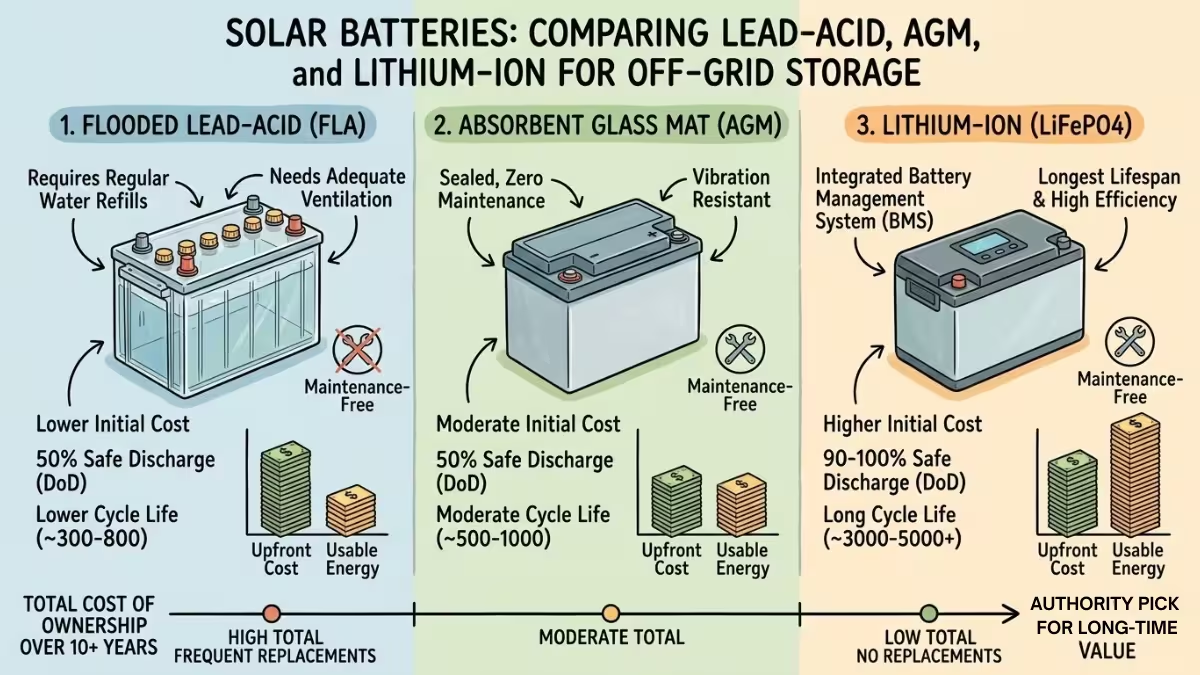
For over a century, Lead-Acid has been the standard for deep-cycle storage, prized for its low initial purchase price.
Flooded Lead-Acid (FLA)
-
The Pros: These are the least expensive solar battery options for off-grid by a wide margin. They are mechanically robust and, when properly maintained, can be very reliable.
-
The Cons: They require constant, physical maintenance (checking and refilling water levels). Crucially, FLA batteries can only be discharged to 50% of their total capacity without causing catastrophic damage, meaning you must buy twice the capacity you actually need.
Absorbent Glass Mat (AGM)
-
The Pros: These are sealed, meaning zero maintenance and no gassing risks, allowing them to be installed indoors or in poorly ventilated areas. They can handle higher surge currents than standard FLA.
-
The Cons: They retain the 50% discharge limit and are significantly more expensive upfront than FLA.
The Modern Standard: Lithium-Ion (LiFePO4)
Lithium-Iron Phosphate (LiFePO4) has become the gold standard for high-performance solar battery options for off-grid storage.
-
Usable Capacity (DoD): Lithium batteries can be safely discharged to 90% or even 100% of their total capacity. A 100Ah Lithium battery provides roughly the same amount of usable energy as a 200Ah Lead-Acid battery.
-
Cycle Life & Lifespan: While Lead-Acid may last 300 to 800 cycles, high-quality LiFePO4 batteries are typically rated for 3,000 to 5,000 cycles—often providing a decade or more of maintenance-free service.
-
Weight & Density: Lithium is 60–70% lighter for the same capacity, making it a critical choice for van life, tiny homes, or any structure with weight constraints.
Comparing the Top Three Storage Technologies
| Metric | Flooded Lead-Acid | AGM (Sealed) | Lithium-Ion (LiFePO4) |
| Upfront Cost | Low | Moderate | High |
| Maintenance | High (add water) | Zero | Zero |
| Safe Discharge (DoD) | 50% | 50% | 90–100% |
| Cycle Life (to 50% DoD) | ~500 | ~800 | ~4,000+ |
| Efficiency (in/out) | ~70-80% | ~80% | ~98-100% |
Integration with Your Solar Lab
The best strategy for selecting solar battery options for off-grid depends on your budget and your plans for the Self-Sufficiency Lab.
-
The Budget Starter: If you are building a small, weekend cabin or starting very cheaply, Flooded Lead-Acid provides a functional path to power.
-
The Mobile Solution: For van conversions or nomadic living, Lithium is the only practical choice due to its extreme weight savings and compact size.
-
The Authority Pick: For a primary residence where reliability is non-negotiable, investing in Lithium-Ion (LiFePO4) is the optimal long-term financial decision. When calculated as cost per usable cycle, Lithium is often cheaper over its total lifespan than Lead-Acid.
Solar Battery Maintenance Audit
-
Lead-Acid Check: (If applicable) Have I physically checked the electrolyte levels in all FLA cells and refilled with distilled water this month?
-
BMS Check: (If applicable) Is the Battery Management System (BMS) for my Lithium bank functional and reporting healthy voltage and temperature?
-
Terminal Torque: Have I checked the tightness of all battery terminals and cleaned any corrosion?
-
Temperature: Are my batteries kept between 40°F and 80°F (4°C to 27°C) to prevent catastrophic loss of cycle life?
-
Max Discharge: (If applicable) Am I ensuring my Lead-Acid bank is never discharged below 50% of its rated capacity?
Conclusion: The Cost of Ownership
Choosing among the various solar battery options for off-grid is about understanding the Total Cost of Ownership, not just the sticker price. While Lithium-Ion requires a significant initial investment, its superior cycle life, 100% usable capacity, and zero maintenance requirements often make it the most economical choice over a ten-year horizon. Invest in the best technology your budget allows; your battery bank is the true heartbeat of your energy independence.